


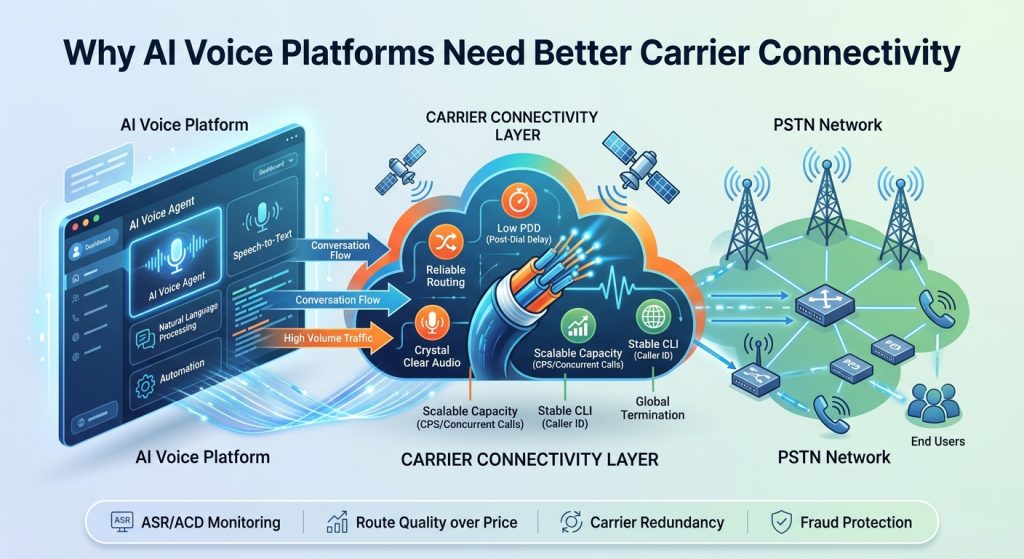
AI voice is moving from simple experiments to real-world conversations. Voice agents are now being used for customer support, appointment scheduling, lead qualification, payment reminders, sales outreach, and other high-volume communication workflows.
But there is an important part of the AI voice stack that often receives less attention: carrier connectivity.
An AI voice platform can have an excellent AI model, natural conversations, and sophisticated automation. Yet if the underlying telecom connectivity is unreliable, the customer experience can still suffer from failed calls, poor audio quality, long post-dial delays, unstable CLI presentation, or limited international reach.
For AI voice platforms, the quality of the carrier connection can directly influence the quality of the voice experience.
What Is Carrier Connectivity for AI Voice?
At a basic level, carrier connectivity provides the bridge between an AI voice platform and traditional telephone networks.
A simplified call path may look like:
AI Voice Agent → Voice Platform → SIP Infrastructure → Carrier → PSTN → End User
The AI handles the conversation. The voice platform manages the application layer. But the carrier is responsible for helping connect that call to the destination telephone network.
This means AI voice providers need more than an API that can initiate a call. They need dependable telecom infrastructure behind that API.
Why AI Voice Creates New Demands on Voice Networks
Traditional voice traffic and AI-generated voice traffic can behave differently.
An AI voice platform may suddenly generate thousands of automated calls based on a campaign, customer workflow, or business event. Traffic can also span multiple countries and destinations.
This creates several important requirements:
- Reliable international termination
- Sufficient concurrent-call capacity
- Appropriate CPS capacity
- Stable routing
- Low post-dial delay
- Consistent voice quality
- CLI requirements appropriate to the destination and use case
- Fast route testing and troubleshooting
- Traffic monitoring
- Redundancy and failover
The challenge isn’t simply connecting a call.
The challenge is connecting potentially large volumes of calls consistently and predictably.
1. Call Quality Matters More When AI Is Speaking
When two people are talking, they may tolerate a small amount of delay or imperfect audio.
AI voice interactions can be less forgiving.
An AI agent needs to detect speech, process the response, generate an answer, and deliver that answer back to the caller. Additional network or carrier latency can make the conversation feel unnatural.
Imagine asking a voice agent a question and waiting several seconds before receiving a response.
The AI may be working perfectly.
The problem could be somewhere in the voice path.
For AI voice platforms, carrier selection should therefore consider not only price but also factors that influence the overall calling experience.
2. Post-Dial Delay Can Affect the User Experience
Post-Dial Delay (PDD) is the time between initiating a call and receiving the appropriate response from the destination network.
High PDD can create an awkward experience.
For example:
AI agent: “Hello, am I speaking with John?”
Caller: “Hello?”
If there is a noticeable delay before the AI responds, the conversation can feel broken or unnatural.
For platforms handling automated voice interactions at scale, monitoring PDD and investigating destinations with consistently poor performance can be important for maintaining a reliable experience.
3. AI Voice Platforms Need Scalable Capacity
One of the biggest advantages of AI voice is scalability.
A company can potentially run hundreds or thousands of simultaneous automated conversations without hiring the same number of human agents.
But that scalability has to exist across the telecom infrastructure as well.
Important capacity considerations include:
Concurrent Calls
How many calls can be active at the same time?
CPS
Calls Per Second (CPS) determines how quickly new calls can be initiated.
Destination Capacity
A route may perform well at a small traffic volume but behave differently when traffic increases.
This is why AI voice providers should evaluate carrier capacity before moving large production traffic.
4. International AI Voice Requires Reliable Global Routing
AI voice platforms often serve customers across multiple markets.
A single platform may need to connect calls to:
- North America
- Europe
- Asia-Pacific
- Middle East
- Africa
- Latin America
Each destination can have different carrier environments, numbering requirements, regulations, CLI considerations, and route performance.
A carrier that performs well in one country may not necessarily provide the same experience in another.
Therefore, AI voice providers should evaluate connectivity destination by destination, rather than assuming that one route or carrier will perform equally well everywhere.
5. CLI Is More Than Just a Number on the Screen
CLI (Calling Line Identification) can be an important part of business calling.
Depending on the destination and use case, AI voice platforms may need specific CLI presentation requirements.
However, CLI behavior can vary by route and destination.
A platform should therefore confirm with its carrier or supplier:
- Whether the required CLI can be presented
- What number formats are supported
- Whether CLI is preserved end-to-end
- Whether local or non-local CLI presentation is supported
- Whether destination-specific restrictions apply
Never assume CLI behavior based solely on the country code or advertised route. It should be confirmed and tested with the carrier before production deployment.
6. Route Quality Should Come Before the Lowest Rate
For wholesale voice, price will always matter.
But for AI voice platforms, selecting a route based only on the lowest rate can become expensive if the route produces poor results.
Consider two routes:
| Metric | Route A | Route B |
|---|---|---|
| Price | Lower | Higher |
| ASR | Lower | Higher |
| PDD | Higher | Lower |
| Stability | Inconsistent | Stable |
| Customer experience | Poorer | Better |
The cheaper route isn’t necessarily the cheaper solution.
If failed or poor-quality calls lead to:
- Lost leads
- Repeated calls
- Customer complaints
- Lower conversion
- Increased support costs
then the apparent savings can disappear quickly.
For AI voice, route quality should be evaluated alongside price.
7. AI Voice Traffic Needs Strong Monitoring
AI voice platforms can generate traffic at a scale that makes manual monitoring difficult.
That’s why providers should track relevant voice metrics, including:
- ASR — Answer-Seizure Ratio
- ACD — Average Call Duration
- PDD — Post-Dial Delay
- CPS — Calls Per Second
- Concurrent calls
- SIP response codes
- Failed-call rates
- Destination performance
Monitoring these metrics by destination can help identify problems before they affect a large percentage of customers.
For example, a sudden drop in ASR for one destination may indicate a routing or carrier issue that deserves investigation.
8. Redundancy Becomes More Important at Scale
Imagine an AI voice platform handling thousands of calls.
If one carrier or route experiences an outage, the impact can be significant.
That’s why larger AI voice platforms may benefit from:
Primary Route → Secondary Route → Failover
A multi-carrier strategy can provide additional resilience when properly engineered.
However, failover should not simply mean sending traffic randomly to another provider. The alternate route should also be tested for quality, capacity, CLI behavior, destination coverage, and commercial terms.
9. Fraud Protection Is Critical for AI Voice
AI voice creates opportunities for legitimate automation—but it can also create risks if telecom infrastructure is not properly protected.
High-volume automated traffic can become a target for:
- Toll fraud
- Account compromise
- Artificial traffic
- Unauthorized international calling
- Unexpected traffic spikes
AI voice platforms should therefore consider controls such as:
- Traffic monitoring
- Spending limits
- Destination restrictions
- Real-time alerts
- Authentication controls
- Unusual-traffic detection
The faster abnormal traffic can be detected, the easier it is to limit potential losses.
10. The Right Carrier Should Understand Your Traffic
Not every carrier is the right fit for every AI voice platform.
Before choosing a wholesale voice partner, AI voice providers should ask:
Coverage
Which destinations are supported?
Capacity
What CPS and concurrent-call capacity can be supported?
Quality
What performance metrics are available for the required destinations?
CLI
What CLI presentation is supported, and what needs to be tested?
Scalability
Can capacity increase as traffic grows?
Monitoring
Can the provider help investigate route performance?
Support
How quickly can routing problems be escalated?
Testing
Can routes be tested before production traffic is introduced?
These questions are often more important than simply asking, “What is your rate?”
The Future of AI Voice Depends on More Than AI
AI models are becoming increasingly capable.
But a voice agent is only as useful as its ability to communicate reliably with the people it is designed to reach.
The future AI voice stack will therefore depend on multiple layers working together:
AI Model + Voice Application + SIP Infrastructure + Carrier Connectivity + PSTN
If one layer performs poorly, the entire experience can suffer.
For AI voice companies looking to scale internationally, carrier connectivity should not be treated as an afterthought. It should be considered a core part of the product architecture.
What Should AI Voice Platforms Look for in a Carrier?
Before moving production traffic, evaluate:
- Route quality
- International coverage
- ASR and ACD performance
- PDD
- CPS and concurrent-call capacity
- CLI requirements
- Route stability
- Monitoring and reporting
- Fraud controls
- Failover options
- Technical support
- Ability to scale
Most importantly, test before you commit significant traffic.
A route that looks attractive on paper still needs to perform under the actual traffic profile of your application.
Frequently Asked Questions
What is carrier connectivity in AI voice?
Carrier connectivity connects an AI voice platform to telephone networks, allowing automated voice agents to make and receive calls through telecom infrastructure.
Why is carrier quality important for AI voice?
Poor carrier connectivity can contribute to failed calls, high PDD, unstable routing, poor audio quality, and inconsistent CLI presentation—all of which can negatively affect AI voice conversations.
What telecom metrics should AI voice platforms monitor?
Common metrics include ASR, ACD, PDD, CPS, concurrent calls, SIP response codes, and failed-call rates.
Does the cheapest VoIP route make sense for AI voice?
Not necessarily. Route quality, stability, capacity, CLI behavior, and overall performance should be evaluated alongside price.
Do AI voice platforms need high CPS?
Many do, particularly when launching large outbound campaigns or handling high-volume automated traffic. The required CPS depends on the platform’s traffic pattern and call volume.
Should AI voice companies use multiple carriers?
For platforms with significant production traffic, multiple carriers or tested failover options can improve resilience. The appropriate architecture depends on traffic volume, destinations, and technical requirements.
Final Thoughts
AI voice is changing how businesses communicate, but the technology behind the conversation is just as important as the AI itself.
Better AI needs better connectivity.
For AI voice platforms, the right carrier partner can help provide the scalability, route quality, international reach, and operational reliability needed to turn an AI voice application into a dependable communications service.
At PW Carrier LLC, we believe voice infrastructure should be evaluated based on more than a rate sheet. Route quality, destination performance, CLI requirements, capacity, and reliability all deserve attention before production traffic is deployed.
Building an AI voice platform? Start by asking whether your telecom infrastructure is ready to scale with it.